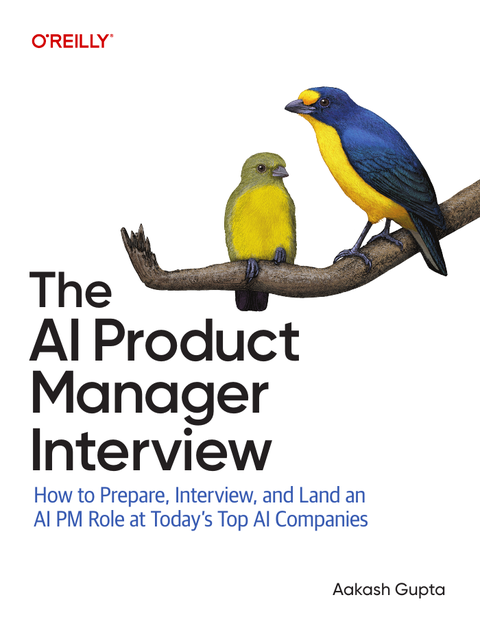
How to prepare, interview, and land an AI PM role at today's top AI companies. Four parts, eighteen chapters, from market map to signed offer.
The AI Product Manager Interview runs four parts and eighteen chapters, from market map to signed offer.
The market, what AI PMs actually do, and the patterns across every interview loop.
Models and the modern AI stack, evals, agents and tool use, production AI, and AI product strategy.
Seven chapters, round by round: recruiter screens, technical, prototyping, product sense, strategy, behavioral, take-homes and onsites.
Resume and sourcing, leveling and negotiation, and your first 90 days on the job.
I write Product Growth and host the Growth Podcast. Over the last few years I have studied the AI PM market, interviewed hiring managers at leading AI companies on the record, coached candidates through difficult loops, and built practical frameworks for AI product sense, evals, safety, and system design.
I have watched candidates land roles at leading AI companies. I have also watched excellent PMs struggle because they prepared for the wrong interview. That gap is why I am writing The AI Product Manager Interview with O'Reilly. The kit is the preview. The book is the full training.
PMs, technical PMs, founders, and product leaders preparing for AI-focused roles.
A free 16-page field guide to the AI PM interview at OpenAI, Anthropic, Google, Google DeepMind, and Meta, with every claim sourced and labeled. Get it here.
No. It combines official company materials with clearly labeled candidate reports, on-the-record interviews, and specialist research. Exact processes vary. The kit explains where the evidence is strong and where it is directional.
It includes candidate-reported prompts with clear source labels. They are not presented as official company question banks.
The 16-page kit immediately, then draft chapters as they are written, selected research, practice cases, and publication details first.
It is forthcoming from O'Reilly. People on the update list will receive publication details first.